BlogName

Search this Blog Content @

Showing posts with label PEOPLE MANAGEMENT. Show all posts

How Successful People Think ?


Everyone has a different definition of success. Successful people prepare themselves mentally everyday so they are prepared to face the challenges in their lives that may arise..

    1. Move On: Fearless people, successful people, are not afraid to move on in life. They
do not waste time feeling sorry for themselves, because they know it is not productive to their end goal. “They have learned to take responsibility for their actions and outcomes, Stop dwelling on the past and bounce back from mistakes faster. This allows them to be more successful in life because they do not waste time being upset about things they cannot change. Instead, they use that time to productively work on conquering new goals.
 
    2. Accept Change: “Mentally strong people embrace change and they welcome challenges.” In order to change yourself, you have to challenge and embrace change. If you are not challenging yourself, you are going to stay in the same spot for the rest of your life or ultimately begin to slip backwards.
 
    3. Remain Resilient: “Every failure is an opportunity to improve.” Successful people fail, too. The difference is that they get back up and keep fighting. No successful person is where they are today because they just slipped through life as casually as an afternoon breeze in the autumn.

    4. Take Calculated Risks: “A mentally strong person is willing to take calculated risks.” Successful people think that risks sometimes bring out the best results in life. They aren’t careless, but rather “weigh the risks and benefits thoroughly, and will fully assess the potential downsides and even the worst-case scenarios before they take action.”

    5. Applaud Others’ Successes: Jealousy and resentment are both emotions that can be incredibly prohibiting to one’s success. “It takes strength of character to feel genuine joy and excitement for other people’s success. Mentally strong people have this ability.” You only get what you work for in life.
 
    6. Own your success or failure: Successful people think in terms of earning potential. They do not “feel the world owes them anything. In order to be successful, it is vital that you think with a strong mind and work for your successes. Successful people think, and think correctly, that if they work hard enough they will eventually earn the wins they want in life. The world does not owe you anything, but the world is much more likely to give things if you work hard for them.

    7. Keep Their Power: “Mentally strong people avoid giving others the power to make them feel good or bad.” Rather than allowing the thoughts of the many different people they come across affect their way of thinking, successful people realize that everybody has the right to have different opinions and that not everybody’s opinions matter or should be taken personally.


' The Start-up of You: Invest in Yourself ' by Reid Hoffman - A brief

Differentiate or Die:

In a world where "a million people can do your job", chart a career path that sets you apart from other professionals. You  don't need to be better than all professions. You just need to be better in a local professional niche.


3 pieces(one that does not work without other) that will consolidate your position in the market:
 
    1. Assets: What you have going for you now. Your soft assets (like knowledge, skills, connections) and hard assets(like cash in the bank)
    
    2. Aspirations & Values: Where you might like to go in the future
    
    3. Market Realities: What people will actually pay you for

One way to upgrade your competitive position is by upgrading your assets - i.e, Investing in Yourself.

Plan to Adapt:

Entrepreneurial career planning and adapting is about being flexibly persistent; always ready to adapt, but also persistent in driving towards set goals. You will never have complete certainty at any point of time; Identify areas of incomplete knowledge about yourself or your industry and make plans that will help you fill those gaps.

 
Prioritize learning over profitability, so you should prioritize learning(soft assets) over salary(hard assets) for the majority of your career. Once we follow the path of "Continuous Learning" in the long run, We are likely to lead a more meaningful life as well as make more money in the process.

Craft a experimental Plan A, an alternative Plan B, and an unchanging, certain Plan Z:

  • Plan A: What you are doing now. Your current implementation of your competitive advantage.
  • Plan B: You pivot to B when your plan is not working or when you discover a better way toward your goal.
  • Plan Z: You shift to Z if something goes seriously wrong. It's the lifeboat you can jump in if your plan fails and you need a re-load before getting back in the game.
People you spend time with shape the person you are today and the person you aspire to be tomorrow. Finally, remember that relationships are like any living thing; if they are not getting stronger, they are getting weaker.

Conclusion:


Start tapping into your network. Start investing in skills. Start taking intelligent risks. Start pursuing breakout opportunities. Most of all, start forging your own differentiated career plans.
 

ref:

The Start-up of You: Adapt to the Future, Invest in Yourself, and Transform Your Career by Reid Hoffman - https://www.amazon.com/Start-Up-Future-Invest-Yourself-Transform/dp/1847940803
 

Success is not about money ..

ref:

Think of happiness as a business best practice and a success fundamental

Career: Ask yourself
  • Am I passionate about the work?
  • Am I one of the world's best at doing this work?
  • Will the market compensate me well enough for it?
Small Business: Much of the potential for success depends upon two things
  • Your ability to effectively function physically, mentally, and emotionally.
  • How well you balance where the business stops and your personal life starts
Money:Truth
  • Wealth only provides options, not a guarantee of happiness.
  • If you can’t be happy without money and stuff, you aren’t likely to be happy with it.

Time Management Tips ..


"Time is beyond our control - the clock keeps ticking regardless of how we lead our lives. Priority management is the answer to maximizing the time we have." – John C. Maxwell

ref:


The time management matrix made popular by the late Stephen R. Covey will help you identify what you really spend your time on. It's a particularly useful tool if you want to know how to prioritize work, personal roles, goals and commitments.


1. Pickle Jar Theory - The Cost of Small Time Consuming Tasks

The Pickle Jar Theory illustrates how relatively unimportant tasks or commitments can easily take up much of a person’s time. Filling one’s day with small trivial tasks that are not important prevents one from using that time to complete larger or more important tasks and projects.


The theory uses a pickle jar and its contents to represent time management. The inside of the pickle jar represents a person’s time, and all the different tasks and commitments that take up that time are represented by rocks, pebbles, sand and water that are placed into the jar.

  • Rocks are the important things that require immediate, significant attention, and produce a huge benefit when they are accomplished.
  • Pebbles produce a benefit, but they are not as important as the tasks represented by the larger rocks.
  • Grains of sand signify small, time-consuming tasks that are relatively easy to do but are of little importance, filling in the leftover space. Things like text messages, constant email checking, and idle chit-chat all take time, but generate little benefit.
  • The final component, water, fills in what little space remains, and represents the tasks and idle moments that fill all the remaining space.
  • The key to using the Pickle Jar Theory is to be aware of which tasks are “rocks,” providing large benefits and requiring immediate attention. Once you know which tasks are “rocks,” you can turn your attention to the “sand,” paring it away to make room for more rocks. Various techniques can be used to diminish the number of grains of sand in the jar.
2. Pareto’s Principle(80/20 Rule) - Focus on the Tasks with the Greatest Benefit

Pareto's principle suggests people can work smarter by concentrating on the important things from which they derive the most benefit. The 80/20 rule, in its broader form, says that a small number of causes is responsible for a large percentage of the effect, in a ratio of about 20:80. In time management, 80% of your results come from 20% of the time and effort you invest or that 20% of tasks absorb 80% of available time. By finding the ideal 20% of your tasks to spend 80% of your energy on, you can avoid wasting time or effort.


3. Parkinson’s Law - Reduce the Time Assigned to Each Task


Parkinson’s Law is simple and straightforward: the time required to complete a particular task will expand according to the amount of time it is allotted. In simple terms, a task will expand to fill any deadline. Giving yourself less time to do something will lead to faster completion. Slowly reduce the time allotted for any given task, and eventually you’ll find the sweet spot in which it gets completed without feeling rushed. Like the other theories, this changes the way you approach using your time, illustrating that less time can lead to better, more effective work.


The secret to massive productivity can therefore be drawn out of this principle: give yourself impossibly short deadlines.  If you must finish it in a day, you will.


4. Newton’s First Law of Motion - What is at rest remains at rest; what is in motion continues in motion

When you’re procrastinating, you’re at rest and, as a rather pleasant state, it’s hard to start doing things. But it also happens that when you’re doing things, you enter in a state of motion, and it’s equally difficult to stop because, after all, the fact of completing tasks is also satisfactory. So keep this in mind, and get to work soon every day. Learn to take the first step doing whatever task is at hand. Tasks in motion tend to get done. So just start ..

Secrets to Success at Work ..

ref: https://www.linkedin.com/pulse/six-secrets-success-work-jack-welch


1. Find Where Your Passion and Skills Intersect


Your career is like a maze, taking multiple directions over the years. On the ultimate path you arrive at the perfect company and do ideal work. In reality, it is difficult to know exactly what you want out of a career ... in fact, it is difficult to even begin to think about it. You took a job that looked good and just kept working at it day in and day out. No longer. It s time to transition to do the work where you belong, at whatever stage you are. 

Ask yourself the five critical questions below:
  • What is your career?
  • Where is your career right now?
  • What do you really want to be?
  • What are you really good at?
  • What do you really love doing? 
You will discover the power of being in the right place, on the ideal career that your skills and passions can create. When you find the work you do well and truly love, you will never work another day in your life.

2. Don’t Fear Failure


You’ll always miss 100% of the shots you don’t take. Defeat is not the worst of failures, Not to have tried is the true failure. It is better to be a failure at something you love than to be a success at something you hate. You have to believe that all past failures and frustrations were actually laying the foundation for the understandings that have created the new level of living I now enjoy.


You build on failure. You use it as a stepping stone. Close the door on the past. You don't try to forget the mistakes, but you don't dwell on it. You don't let it have any of your energy, or any of your time, or any of your space.


3. Never Stop Reinventing Yourself


Who wants to just “retire”? Banish that word from your vocabulary. You have got to constantly reinvent and take a chance on something you’ve always wanted to do - it’s what keeps you alive. You’re never done. Change is the only constant thing in life.


We have had to change careers several times. Sometimes because our interests changed. Sometimes because all bridges have been burned beyond recognition, sometimes because we desperately needed money. And sometimes just because We hated everyone in the old career or they hated us. What ever the reason, every day you reinvent yourself. You’re always in motion. But you decide every day: forward or backward ..


4. Give Yourself a Deadline

Don’t let work feel like a grind. If you're unhappy or you just are not all-in, you have to put a time-frame on how much you are going to put up with before making a change. With a deadline, you are constantly reminded of how valuable and precious your time is. You’re able to see resources and opportunities that would otherwise remain hidden.A deadline encourages you to do the best you can with what you have. And that’s a skill that reliably leads to great accomplishment again and again.


A deadline provides a firm boundary for your efforts, yet it does not limit or constrain those efforts. On the contrary, a deadline will focus your efforts toward a single point, giving them more power and practical effectiveness. Without a deadline you can exhaust yourself and still not arrive at any meaningful accomplishment. A deadline compels you to prioritize and to expend your best efforts in the most meaningful direction.

5. Make Your Boss look Smarter

If your boss is successful, there’s a greater chance you’ll be successful too. See yourself as a complement to the person. Find a way to compensate for his weaknesses. If he is not good at seeing the big picture, ask questions that help him pull back from the details. If he does not understand the technical ins and outs of your product, offer to cover the part of a meeting where the features will be discussed. Offer up ways that he or she can use you better. No matter where you are in your career, one thing never changes - Every day, it’s your flat-out responsibility to make your boss look good. You have to make him or her look smarter.

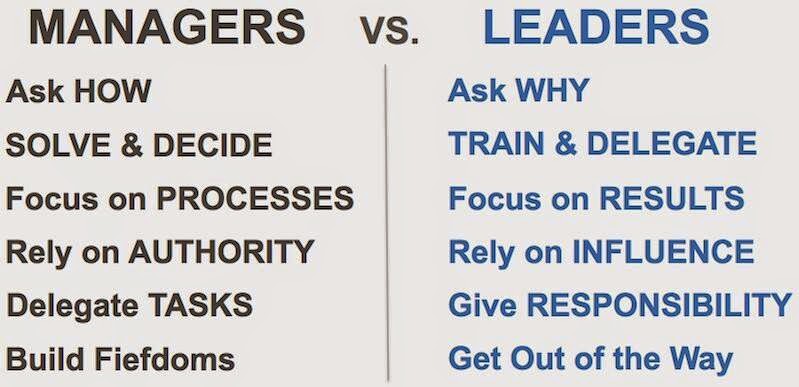
Managers vs Leaders

ref: http://guides.wsj.com/management/developing-a-leadership-style/what-is-the-difference-between-management-and-leadership/

Leadership and management must go hand in hand; They are not the same thing. But they are necessarily linked, and complementary. The manager’s job is to plan, organize and coordinate. The leader’s job is to inspire and motivate.


Read a book today ...


“There is no friend as loyal as a book.” - Ernest Hemingway
 
“I cannot live without books.” - Thomas Jefferson
 

“A room without books is like a body without a soul.” - Marcus Tullius Cicero

“That's the thing about books. They let you travel without moving your feet.” - Jhumpa Lahiri, The Namesake


“A great book should leave you with many experiences, and slightly exhausted at the end. You live several lives while reading.” - William Styron, Conversations with William Styron
 

.. Now let's make a new life long friend by reading a book ...


Life

Inspiration - https://drive.google.com/folderview?id=0B_hC-3L4eq17bktNVWJHbHk3Zjg&usp=sharing_eid

Psychology - https://drive.google.com/folderview?id=0B_hC-3L4eq17LWRzRW43NnZTdGc&usp=sharing_eid

People Management - https://drive.google.com/folderview?id=0B_hC-3L4eq17dlhVV3VJQXlSaVk&usp=sharing_eid


Financial Management - https://drive.google.com/folderview?id=0B_hC-3L4eq17VHRlSzN2bS1VSms&usp=sharing_eid


Jiddu Krishnamurthy - http://www.jiddu-krishnamurti.net/en/krishnamurti-ebooks-free-download


Technology

Software Architecture - https://drive.google.com/folderview?id=0B_hC-3L4eq17YVFtQXRKN1Y1SnM&usp=sharing_eid

Richard Stevens(Unix) - https://drive.google.com/folderview?id=0B_hC-3L4eq17QzgtdkFVU0pXT2s&usp=sharing_eid

Linux Programming - https://drive.google.com/folderview?id=0B_hC-3L4eq17T29hNmpYNTNQSmM&usp=sharing_eid


Hadoop - https://drive.google.com/folderview?id=0B_hC-3L4eq17VFZfdVE0Z2NCUzQ&usp=sharing_eid

Arduino - https://drive.google.com/folderview?id=0B5BO97vHUkN2VzEzTXFtRS1tSXc&usp=sharing_eid

Technology miscellaneous - https://drive.google.com/folderview?id=0B_hC-3L4eq17aUhtODlfa25Idlk&usp=sharing_eid


Miscellaneous

Kids - https://drive.google.com/folderview?id=0B_hC-3L4eq17WU1uckJGa1NVYXc&usp=sharing_eid 


Miscellaneous - https://drive.google.com/folderview?id=0B_hC-3L4eq17bEthMS1VY0dLLUE&usp=sharing_eid


Journals


YOJANA(govt of india public administration journal) in Telugu - https://drive.google.com/folderview?id=0B_hC-3L4eq17TDdhWndMVThyckk&usp=sharing_eid 

KURUKSHETRA(govt of india rural administration journal) - https://drive.google.com/folderview?id=0B5BO97vHUkN2ZnAxWWhwLUswekk&usp=sharing_eid


Telugu

BhagavadGita - 
https://drive.google.com/folderview?id=0B5BO97vHUkN2fm5sOTh6THhKZEdjNzlmSG9FcGhfNXJsQ0RfVUwtWlNsOG16eXhjbG14R0E&usp=sharing_eid

Andhra Culture - https://drive.google.com/folderview?id=0B_hC-3L4eq17aGxna1hrWUtXbWM&usp=sharing_eid

Yandamuri Veerendranath - https://drive.google.com/folderview?id=0B_hC-3L4eq17MDVJYW0wY09ibDg&usp=sharing_eid

Oka Yogi Aathma Katha - https://drive.google.com/folderview?id=0B_hC-3L4eq17R0tPQkphRVRiYlU&usp=sharing_eid 


Telugu Miscellaneous - https://drive.google.com/folderview?id=0B5BO97vHUkN2ZC1sTEd1RmJEMUU&usp=sharing_eid


Telugu Miscellaneous(from other blogs) - 

    Success mantra = Learn, Unlearn and Relearn

    ref:

    Success is liking yourself, liking what you do, and liking how you do it

    Success breeds success across all walks of life & the main ingredient of success is having success. Critical element of success is self-confidence; you don't need other people's approval. Success can make you smarter, and more able to think of new ideas. Anyone can experience success; It's all in the mind !

    Failures are a part of life. They are an essential element to moving forward, and going after what you want. If you’re not failing, it means you’re not in action or being bold enough! So, expect failures. Welcome them in. It means you’re growing, stretching and trying new things. In order to create room for the things we want in life, we must be willing to release what hasn’t been working (ie. failures) so we have room to invite things that will work. If there’s no room for all that, it will always be waiting for you, off in the distance, until your past failures are released. You can't fly if your wings are holding the baggage of yesterday. Let go and Fly !

    Have someone on your side that you can count on for honest feedback.  Find out what you could’ve done better, what needs a little sharpening, and what areas you may have missed.  We all have blind spots, and we need someone else to shine a light on them.  Once you know what to focus on, apply apply apply !

    Never get too comfortable in your last success…that is the biggest failure. Always push for a new benchmark and a new “top.”  Pushing your comfort zone, stretching and challenging yourself is the key. 

    I failed, and I'm still alive. What worse could happen? Let's take another risk and see ...


    Leadership lessons ...

    ref: http://www.entrepreneur.com/article/241160

    If your actions inspire others to dream more, learn more, do more and become more, you are a leader. Leadership and learning are indispensable to each other. Leadership is all about doing the right things.

    1. Be a great communicator- someone who's both an inquisitive conversationalist and an engaged, active listener.  Everyone wants to be heard. connect to people by asking more open-ended questions, such as "Tell me, what did you enjoy the most in today's Tech-Talk?"

    2. Trust people - Trust is everything. Delegate responsibility, trust people and make them accountable .. Miracles happen .. At the end of the day, it's all about people !

    3. Continuous learning - Leaders who are continuously learning are challenging their own assumptions and bringing more knowledge to the table each time they converse. Self-learning is the key. The day you stop learning is the day you stop living.

    4. Stay positive - High-performing leaders understand that staying positive not holding grudges, dwelling on problems, or spending time focusing on negative influences  is an integral part setting and accomplishing their goals.

    5. Meticulous Time management - As a leader, you may be frequently interrupted or pulled in different directions. While you cannot eliminate interruptions, you do get a say on how much time you will spend on them and how much time you will spend on the thoughts, conversations and actions that will lead you to success. 

    6. Build momentum incrementally - Don’t be intimidated by the scope of your idea; create smaller checkpoints that build up to your bigger achievement. Resilient leaders push themselves to accomplish their goals, but allow some room to change or improvise as they go.  
      
    7. Constructive failure handling - We have all experienced failure, but there are ways you can learn from these obstacles and channel them into something even more fulfilling. Disciplined leaders who aren’t afraid to fail, and who take time to recharge and help others are well on their way to long-term success.

    8. Be a Entrepreneur - Hardworking, driven, competitive, collaborative, imaginative, a people person or a problem-solver .. An innovative leader is always on the lookout for new opportunities and prospects and points of view, wherever they go. A successful entrepreneur knows they can't go it alone and that there is always something new to learn. 

    9. Consistent good habits - exercise, eat healthy, read voraciously and network, network, network ...


    Leadership is the art of getting someone else to do something you want done because he wants to do it.


    Building strong teams ...

    ref: http://www.entrepreneur.com/article/241216

    A strong team is never satisfied. They know they can do it better than they did it yesterday, and they are excited to come to work every day saying, How do I do it better?


    Company Work Culture:

    Peter Drucker quote - “culture eats strategy for breakfast”. It's really the people that make any company the kind of company it is. It's the shared values and practices of the company's employees. It's all about laying the groundwork for a strong, unified, communication-driven, supportive and fun culture. Culture actually drives the value of the business. 

    Know the team:
    Know your team personally and professionally. Spending more time with people and socializing with them, you will learn more about your team. More you engage with them personally, they become engaged professionally. Facilitate to Identify the strengths and weaknesses of the team, then fill in the gaps.

    Engage the team:
    People are engaged with leaders who share, communicate and hold themselves accountable when they did not make the right decision. Set short term goals that employees can hit quickly and accomplish the joy of being successful. People who succeed have momentum; the more they succeed, the more they want to succeed, and the more they find a way to succeed; Fail fast, learn fast and innovate.

    Trust and Accountability:
    The secrets to successful teamwork: Trust and accountability. Trust and respect are two essential elements for building relationships in the workplace and beyond. It’s all about the relationships you have with people which does not necessarily mean friendships. Relationships are built over time, when one person has respect for another. Gradually, trust begins to build, too. You don’t have to be a close personal friend with everyone at work, but you do always need to show each person respect and professionalism.


    Start Your Business With Little to No Capital - essential qualities

    ref: http://www.entrepreneur.com/article/236961

    If your idea and plan of execution aren’t well thought out from the beginning, no amount of money can turn it into a winner. Have a great idea but very little money? Don’t let that stop you! Yes, there will be ridiculously long days with little to no sleep. Yes, you are going to be stressed. But those that want it bad enough will make it. Hard work is an absolute necessity, but when you are starting a business with little to no capital then you must be prepared to dedicate everything you have into making the business a success. This might mean cold calling, handling customer support, dealing with billing and accounting, and every other working part of your business. You will wear many hats and it will require the majority of your time and energy if you are to make it.
    Here are eight tips that can help you get your idea off the ground with limited funds:
    1. Build your business around what you know. 
    2. Tell everyone you know what you are doing. 
    3. Avoid unnecessary expenses. 
    4. Don’t get buried in credit card debt.
    5. Make sure your receivables policy won’t sink you. 
    6. Build up sweat equity. 
    7. Take advantage of free advertising and marketing. 
    8. Get ready to hustle.

    How Successful People Make The Most Of Their Weekends

    ref: http://www.businessinsider.com/successful-people-weekends-2014-1?op=1#ixzz3GnBkeGuj
    1. The first step to controlling your weekends is making conscious choices.
    2. Make sure to unplug completely for at least a few hours.
    3. Make appointments for yourself, even if it's only to read a book.
    4. Keep chores, errands, and busy work to a minimum on your days off.
    5. Planning actually makes weekends happier, and unlocks a key mechanism of joy.
    6. Plan three to five anchor events each weekend, but don't plan out every hour.
    7. Make a list of the things you dream about doing, and you'll find the ones you can do every day.
    8. As you make your plans, don't discount something you haven't done in years.
    9. Weekend mornings can be the best time to do things for yourself.
    10. Establish small habits to create new traditions for your family.
    11. Set aside specific hours for down time, and turn off your phone.
    12. Be sure to make plans for Sunday night so you don't sit around stressing about your job.

    Y Combinator

    Masters of Scale - YOUTUBE

    The Diary Of A CEO INTERVIEWS

    Nikhil Kamath

    Aswath Damodaran

    Vishal Khandelwal

    MIT OpenCourseWare

    Stanford Online

    Hugging Face - Blog

    Hugging Face Papers

    Columbia Business School

    Wharton School

    The University of Chicago Booth School of Business

    CEO Entrepreneur

    Entrepreneur India TV

    Think School (INDIA)

    Goldman Sachs

    Morningstar, Inc.

    The Motley Fool

    TEDx Talks

    Josh Talks

    జోష్ Talks

    GaryVee ENTREPRENUER

    Ben Felix

    The Money Guy Show