BlogName

Search this Blog Content @

Showing posts with label PROJECT MANAGEMENT. Show all posts

Effective Goal Setting ..


Setting goals is a matter of knowing what you want and properly allocating your resources - primarily time and money - to reach your desired ends. Create SMARTPLUS(Specific, Measurable, Attainable, Rewarding, Timely ,Positive, Linked, Unbundled, Shifting) goals ..


Your Goal Statement Template:

1. Goal =>

    I will know I'have met this goal when:
    I will accomplish this goal by/within:
 

Things that motivate employees more than MONEY

You don’t need to be hot; You just need to be successful and those are two different things. Success often comes from doing a few things extraordinarily well and noticeably better than the competition.

1. Catch People in the act of doing things Right not Wrong: Everyone wants to be recognized and it's the basic instinct of being a human and  good news is that it’s one of the easiest things to give. Appreciate every improvement that you see your team members make.

2. Make your ideas theirs: People hate being told what to do. Instead of telling people what you want done; ask them in a way that will make them feel like they came up with the idea. “I’d like you to do it this way” turns into “Do you think it’s a good idea if we do it this way?”


3. Instantaneous feedback: Instantaneous appreciation/criticism are highly effective because the feedback is immediate, unlike the annual reviews where you are charged for things committed several weeks or months ago.

4. Appreciate in public:  Once you’re comfortable delivering appreciation one-on-one to an employee, try appreciating them in front of others. Highlight your top performers’ strengths and let them know that because of their excellence, you want them to be the example for others. You’ll set the bar high and they’ll be motivated to live up to their reputation as a leader.

5. Never criticize in public: No one, and I mean no one, wants to hear that they did something wrong in public; Take it to the private conversations. Try an indirect approach to get people to improve, learn from their mistakes, and fix them. Ask, “Was that the best way to approach the problem? Why not? Have any ideas on what you could have done differently?” Then you’re having a conversation and talking through solutions, not pointing a finger.

6. Empower people to take decisions and make them accountable:  Encourage Agile(Learn, Unlearn, Relearn - "Fail Fast, Fail Often, Learn Fast"); Foster Open Communication; Reward self-improvement;  Clearly define Roles; Appreciate honest efforts

7. Give recognition and small rewards: These two things come in many forms: Give a shout out to someone in a company meeting for what she has accomplished. Try simple things like lunch, dinner, family vacation, trophies, spa services, and plaques.

      Critical skills to success while climbing corporate ladder ..

      Critical skills to success while climbing corporate ladder:
      1. Influencing right people
      2. Focus on your strengths not weakness
      3. Communication and get noticed by those who matter
      4. Network, network, network
      5. Articulate stories(context, problem, solution) well backed by facts
      6. Self development/improvement

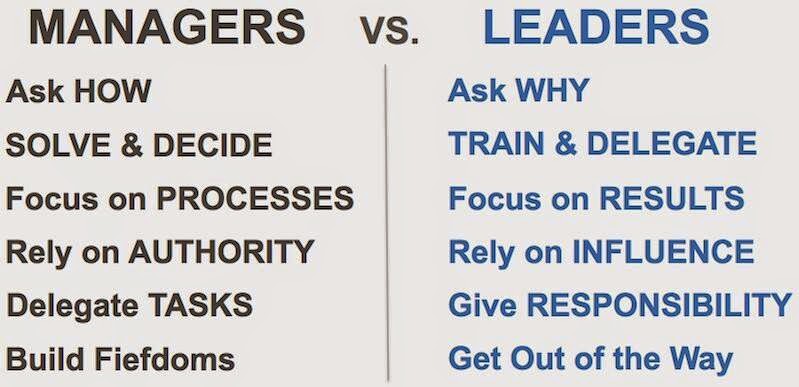
      Managers vs Leaders

      ref: http://guides.wsj.com/management/developing-a-leadership-style/what-is-the-difference-between-management-and-leadership/

      Leadership and management must go hand in hand; They are not the same thing. But they are necessarily linked, and complementary. The manager’s job is to plan, organize and coordinate. The leader’s job is to inspire and motivate.


      Career advice at work ..


      1. Do what matters early on

      Focus on identifying specific tasks or objectives you can achieve early on to establish your reputation as someone who gets things done. Be sure to choose a goal that matters to the company and its business objectives.
      - Ryan Stoner, ryanstoner.com

      2. Focus on the problem in its simplest form

      One of the most important things you can learn as an entrepreneur is to focus on the problem in its simplest form, one that you can describe in one sentence. Then come up with the simplest answer to that problem. If you know a problem exists, then you can determine the demand for an actual solution.
      - Andy Karuza, SpotSurvey

      3. Listen more than you talk

      Listening carefully with 100% focus and commitment is such an important thing. My colleague is great at it, and every time I am reminded that by just listening well, you pick up a lot of what it eventually takes to succeed, or, for example, to complete a final sale. Customers will literally tell you what they need when asked.
      - Ridaa Murad, Christina Ventures

      4. Over-prepare, and then go with the flow

      Whether it’s sales calls, meetings, presentations or anything else associated with job-related duties, over-prepared individuals can relax once they are in the hot seat. It gives you the ability to maintain a grace under fire and creates room for necessary improvisation and flexibility. Nothing will ever turn out as planned, and when you are over-prepared, you can compensate for this dynamic.
      - Jon Cline, Rokit SEO

      5. Slow down

      I walk quickly, especially when I’m at an event location and getting things done. At one of my first large events, a colleague told me to slow down—more specifically, to saunter. When I slowed down my walking, my brain slowed down. And during the walk from Point A to Point B at an event location, I could better assess how to handle four tasks at once. Saunter is my new middle name.
      - Sydney Owen Williams, Planet Green Socks


      ref:

      13 Pieces of Career Advice to Help You Flourish at Work - http://success.com/article/13-pieces-of-career-advice-to-help-you-flourish-at-work


      24 Proven Steps to Make You a Master Networker - http://www.entrepreneur.com/article/243159


      50 Quotes on Leadership Every Entrepreneur Should Follow - http://www.entrepreneur.com/article/243861

      Pert & Gantt Charts

      PERT => Program Evaluation and Review Technique

      You can also estimate an activity's duration by using the Program Evaluation and Review Technique (PERT) formula. PERT weighs the average of the pessimistic (P), most likely (M), and optimistic (O) estimates for an activity. For example:

      PERT formula = (P+4M+O) / 6

      In the following example there are seven tasks, labeled a through g. Some tasks can be done concurrently (a & b) while others cannot be done until their predecessor task is complete (c cannot begin until a is complete). Additionally, each task has three time estimates: the optimistic time estimate (a), the most likely or normal time estimate (m), and the pessimistic time estimate (b). The expected time (TE) is computed using the formula (a + 4m + b) /6.

      A Gantt chart is a popular type of bar chart that illustrates a project schedule. Gantt charts illustrate the start and finish dates of the terminal elements and summary elements of a project. Terminal elements and summary elements comprise the work breakdown structure of the project. Some Gantt charts also show the dependency (i.e., precedence network) relationships between activities.

      Gantt charts don't illustrate task dependencies & PERT charts can be confusing, PMs often use both.

      Links:
      Pert, CPM , Gantt - http://studentweb.tulane.edu/~mtruill/dev-pert.html

      http://en.wikipedia.org/wiki/Program_Evaluation_and_Review_Technique

      http://blogs.techrepublic.com.com/tech-manager/?p=548&tag=nl.e053

      http://searchsoftwarequality.techtarget.com/generic/0,295582,sid92_gci1301351,00.html

      http://en.wikipedia.org/wiki/Gantt_chart

      http://gates.comm.virginia.edu/rrn2n/teaching/gantt.htm

      http://www.12manage.com/methods_gantt_chart.html

      Project Management Professional(PMP) Exam Preparation

      1. Read PMBOK

      2. Read 'How to pass PMP on your first try - Andy Crowe' (Easy to read and grasp)

      3. Read Delegation chapter by Vijay Verma from the PMI site (eReads and Reference)

      4. Read 'PMP Exam Prep' - Rita Mulcahy

      5. Read 'Project management professional' - study guide by Kim Heldman, PMP

      6. Read 'The project management Question and answer book' by Michael W.Newell, PMP and Marina N. Grashina, PMP

      7. Read 'PMP Exam Prep 2005 Fifth edition- Rita flash cards' (also known as hot topics, for quick review, to remember key things)

      8. Rita PMP slides

      9. Go through lots of practice exam from Pmstudy, Oliver's test questions, Head first sample 200 questions, Pmzilla questions.


      ref:

      pmi site - http://www.pmi.org/Pages/default.aspx

      pmp bank - http://pmpbank.googlepages.com/

      pmp tips - http://pmtips.net/

      pmp blog - http://pmp-preparation.blogspot.com/

      pmhub forums - http://www.pmhub.net/

      pmp campus - http://www.pmcampus.com/

      PMP Practice Questions - http://www.testprepreview.com/pmp_practice.htm

      PMP Preparation Tests - http://www.preparepm.com/

      PMP Sample Test - http://pmzilla.com/

      project management training online - http://www.pmtrainingonline.com/

      175 PMP Questions - http://www.oliverlehmann.com/contents/free-downloads/175_PMP_Sample_Questions.pdf

      How to Prepare to Pass the PMP Exam - http://www.ehow.com/how_4920859_prepare-pass-pmp-exam.html

      How to Study for the PMP Exam and Pass - http://www.ehow.com/how_4821961_study-pmp-exam-pass.html

      How to Ace the PMP Exam - http://www.ehow.com/how_4860084_ace-pmp-exam.html4860084_ace-pmp-exam.html


      PMP or CAPM, ITIL, CBAP, ISO 20000, and COBIT.

      Trainers recommended five key process-oriented certifications that career-minded IT staff should consider getting: PMP or CAPM, ITIL, CBAP, ISO 20000, and COBIT.

      The Project Management Institute's Project Management Professional (
      PMP) credential requires three to five years of direct project management experience just to get in the door. For those who don't have the requisite experience, the Certified Associate in Project Management (CAPM) is a good start, indicating that you have a fundamental knowledge of project management principals as defined by the PMI and can be a valuable contributor to a project team as a subject matter expert, liaison, or coordinator.

      With companies struggling to run IT more like a service organization aligned to company business objectives,
      ITIL is the third key process-oriented certification to get. The ability to effectively collect, define, and manage customer requirements are especially valuable skills in project management.

      A certification that is especially useful for gaining skills in gathering customer requirements is the International Institute of Business Analysts' Certified Business Analysis Professional (
      CBAP), Lora says. The CBAP requires five years of business analysis experience, but you can often get credit for many aspects of your IT project management.

      Knowing how to measure risk and success effectively is also a process skill in demand. For that, you're looking at
      ISO 20000 or COBIT training. ISO 20000 is an international standard for delivery of IT services based on customer requirements, and COBIT is a set of best practices for IT management.

      Ref :
      http://www.globalknowledge.com/training/generic.asp?pageid=2275&country=United+States&translation=English

      PMP and PRINCE2

      - PRojects IN Controlled Environments - is a major worldwide project management framework, or methodology. It takes a different approach than the PMI's PMBOK, but the goal of both is to improve project performance.

      While PMBOK is generally well-accepted worldwide, it is by far the leading approach in North America. PRINCE2 on the other hand is strongest in the United Kingdom, with a strong presence in Europe, Australia, and other typically English-speaking countries outside North America. But both are expanding there reach on a constant basis as the world gradually "projectizes."


      PMP Preparation:
      Font size
      1. PMBOK - Essential

      2. How to pass PMP on your first try - Andy Crowe (Easy to read and grasp)

      3. Delegation chapter by Vijay Verma from the PMI site (eReads and Reference)

      4. PMP Exam Prep - Rita Mulcahy

      5. Project management professional - study guide by Kim Heldman, PMP

      6. Lots of practice exam from Pmstudy, Oliver's test questions, Head first sample 200 questions, Pmzilla questions.

      7. The project management Question and answer book by Michael W.Newell, PMP and Marina N. Grashina, PMP

      8. PMP Exam Prep 2005 Fifth edition- Rita flash cards (also known as hot topics, for quick review, to remember key things)

      9. Rita PMP slides (Presentation which they have provided us in class)

      Links:

      PMP Information -
      http://www.pmi.org/

      PMP Practice Questions -
      http://www.testprepreview.com/pmp_practice.htm

      PMP Preparation Tests -
      http://www.preparepm.com/

      PMP Sample Test -
      http://pmzilla.com/

      Prince2 Information -
      http://www.prince2.com/prince2-downloads.asp

      Prince2 Free Computer based Trainings -
      http://www.iplazza.eu/

      Prince2 Exam Sample Quesions -
      http://prince2.technorealism.org/index.php?page=Prince2_Exam_Questions

      Prince2 Exam Sample Quesions -
      http://www.prince2.com/prince2-exams.asp

      Prince2 Faq -
      http://www.prince2.com/prince2-faqs.asp

      Prince2 Guide -
      http://www.ruleworks.co.uk/cgi-bin/TUfaq.exe?Guide=Prince2

      Prince2 Primer -
      http://www.projectinabox.org.uk/prince2primer.asp

      Advantages of doing PMP : A Discussion -
      http://projectmanagement.ittoolbox.com/groups/career/projectmanagement-career/value-of-pmp-certification-1774519

      Compare PMP & Prince2 =>
      http://www.aipm.com.au/resource/A%20comparison%20of%20Prince%202%20vs%20PMBOK.pdf

      Compare PMP & Prince2 =>
      http://www.aipm.com.au/resource/A%20comparison%20of%20Prince%202%20vs%20PMBOK.pdf

      Compare PMP & Prince2 -
      http://www.maxwideman.com/papers/comparing/comparing.pdf

      Comparing PRINCE2 and PMBOK – 3 Perspectives -
      http://pmcrunch.com/certification/comparing-prince2-and-pmbok-%E2%80%93-3-perspectives/

      How Prince2 can complement PMBOK & your PMP -
      http://www.pmiwestchester.org/downloads/Prince2PMBOK.pdf

      PMP & Prince2 -
      http://manage.wordpress.com/2006/11/24/prince2-vs-pmp/

      Tips for Metrics Success

      Despite the challenges, many software organizations routinely measure aspects of their work. If you wish to join this club, keep the following tips in mind.

      Start Small. Because developing your measurement culture and infrastructure will take time, use GQM to first select a basic set of initial metrics. Once your team becomes used to the idea of measurement and you have established momentum, you can introduce new metrics that will give you the additional information you need to manage your projects and organization effectively.

      A risk with any metrics activity is dysfunctional measurement, in which participants alter their behavior to optimize something that isbeing measured, rather than focusing on the real organizational goal. For example, if you are measuring productivity but not quality, expect some developers to change their coding style to expand the volume of material they produce, or to code quickly without regard for bugs. I can write code very fast if it doesn’t actually have to run correctly. The balanced set of measurements helps prevent dysfunctional behavior by monitoring the group’s performance in several complementary aspects of their work that lead toproject success. Never attempt to use metrics to motivate performance.

      Explain Why. Be prepared to explain to a skeptical team why you wish to measure the items you choose. They have the right tounderstand your motivations and why you think the data will be valuable. Use the data that is collected, rather than letting it rot in the dark recesses of a write-only database.

      Share the Data. Your team will be more motivated to participate in measurement activities if you inform them about how you’ve used the data. Share summaries and trends with the team at regular intervals and get them to help you understand what the data is tellingyou. Let them know whenever you’ve been able to use their data to answer a question, make a prediction, or assist your management efforts.

      Define Data Items and Procedures. It is more difficult and time-consuming to precisely define the data items and metrics than youmight think. However, if you don’t pin these definitions down, participants may interpret and apply them in different ways. Define whatyou mean by a "line of code," spell out which activities go into the various work effort categories, and agree on what a "defect" is. Write clear, succinct procedures for collecting and reporting the measures you select.

      Understand Trends. Trends in the data over time are more significant than individual data points. Some trends may be subject tomultiple interpretations. Did the number of defects per function point found during system testing decrease because the latest round of testing was ineffective, or did fewer defects slip past development into the testing process? Make sure you understand what the data istelling you, but don’t rationalize your observations away.

      Measurement alone will not improve your software performance, but it provides information that will help you focus and evaluate your software process improvement efforts. Link your measurement program to your organizational goals and process improvement program. Use the process improvement initiative to choose improvements, use the metrics program to track progress toward your improvement goals, and use your recognition program to motivate and reward desired behaviors.

      Y Combinator

      Masters of Scale - YOUTUBE

      The Diary Of A CEO INTERVIEWS

      Nikhil Kamath

      Aswath Damodaran

      Vishal Khandelwal

      MIT OpenCourseWare

      Stanford Online

      Hugging Face - Blog

      Hugging Face Papers

      Columbia Business School

      Wharton School

      The University of Chicago Booth School of Business

      CEO Entrepreneur

      Entrepreneur India TV

      Think School (INDIA)

      Goldman Sachs

      Morningstar, Inc.

      The Motley Fool

      TEDx Talks

      Josh Talks

      జోష్ Talks

      GaryVee ENTREPRENUER

      Ben Felix

      The Money Guy Show