BlogName

Search this Blog Content @

Showing posts with label LEADERSHIP. Show all posts

Building Resilience

How do people deal with difficult events that change their lives? The death of a loved one, loss of a job, serious illness, terrorist attacks and other traumatic events: these are all examples of very challenging life experiences. Many people react to such circumstances with a flood of strong emotions and a sense of uncertainty. Yet people generally adapt well over time to life-changing situations and stressful conditions. What enables them to do so? It involves resilience, an ongoing process that requires time and effort and engages people in taking a number of steps.

Resilience is the process of adapting well in the face of adversity, trauma, tragedy, threats or significant sources of stress. Resilience means "bouncing back" from difficult experiences. Psychologists believe that resilient individuals are better able to handle such adversity and rebuild their lives after a catastrophe. Dealing with change or loss is an inevitable part of life. At some point, everyone experiences varying degrees of setbacks. Some of these challenges might be relatively minor (not getting into a class you wanted to take), while others are disastrous on a much larger scale (hurricanes, tornadoes, terrorist attacks). How we deal with these problems can play a significant role in not only the outcome but also the long-term psychological consequences. Social support is another critical variable that contributes to resilience. Mentally strong people tend to have the support of family and friends who help bolster them up in times of trouble.

Building resilience include:

  • Accept that change is a part of living
  • Holding positive views of themselves and their abilities
  • Make Connections. Being a good communicator
  • Look at the big picture. Move toward your goals. Keep things in perspective
  • Building mental toughness(Viewing themselves as fighters rather than victims)
  • Having an internal locus of control
  • Learn something new
  • Having high emotional intelligence and managing emotions effectively

ref:

What Is Resilience? - http://psychology.about.com/od/crisiscounseling/a/resilience.htm

Building your resilience - http://www.apa.org/helpcenter/road-resilience.aspx

6 Key Steps For Career Resilience - http://www.forbes.com/sites/kerryhannon/2012/12/26/6-key-steps-for-career-resilience/

' The Start-up of You: Invest in Yourself ' by Reid Hoffman - A brief

Differentiate or Die:

In a world where "a million people can do your job", chart a career path that sets you apart from other professionals. You  don't need to be better than all professions. You just need to be better in a local professional niche.


3 pieces(one that does not work without other) that will consolidate your position in the market:
 
    1. Assets: What you have going for you now. Your soft assets (like knowledge, skills, connections) and hard assets(like cash in the bank)
    
    2. Aspirations & Values: Where you might like to go in the future
    
    3. Market Realities: What people will actually pay you for

One way to upgrade your competitive position is by upgrading your assets - i.e, Investing in Yourself.

Plan to Adapt:

Entrepreneurial career planning and adapting is about being flexibly persistent; always ready to adapt, but also persistent in driving towards set goals. You will never have complete certainty at any point of time; Identify areas of incomplete knowledge about yourself or your industry and make plans that will help you fill those gaps.

 
Prioritize learning over profitability, so you should prioritize learning(soft assets) over salary(hard assets) for the majority of your career. Once we follow the path of "Continuous Learning" in the long run, We are likely to lead a more meaningful life as well as make more money in the process.

Craft a experimental Plan A, an alternative Plan B, and an unchanging, certain Plan Z:

  • Plan A: What you are doing now. Your current implementation of your competitive advantage.
  • Plan B: You pivot to B when your plan is not working or when you discover a better way toward your goal.
  • Plan Z: You shift to Z if something goes seriously wrong. It's the lifeboat you can jump in if your plan fails and you need a re-load before getting back in the game.
People you spend time with shape the person you are today and the person you aspire to be tomorrow. Finally, remember that relationships are like any living thing; if they are not getting stronger, they are getting weaker.

Conclusion:


Start tapping into your network. Start investing in skills. Start taking intelligent risks. Start pursuing breakout opportunities. Most of all, start forging your own differentiated career plans.
 

ref:

The Start-up of You: Adapt to the Future, Invest in Yourself, and Transform Your Career by Reid Hoffman - https://www.amazon.com/Start-Up-Future-Invest-Yourself-Transform/dp/1847940803
 

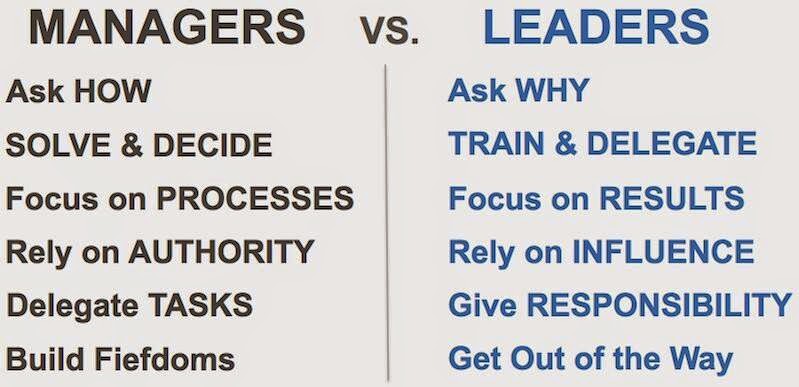
Managers vs Leaders

ref: http://guides.wsj.com/management/developing-a-leadership-style/what-is-the-difference-between-management-and-leadership/

Leadership and management must go hand in hand; They are not the same thing. But they are necessarily linked, and complementary. The manager’s job is to plan, organize and coordinate. The leader’s job is to inspire and motivate.


10 Rules of Success ...

"The ideas I stand for are not mine. I borrowed them from Socrates. I swiped them from Chesterfield. I stole them from Jesus. And I put them in a book. If you don’t like their rules, whose would you use?" - Dale Carnegie

Carnegie 10 Rules of Success ...


1. Never say, “You’re wrong.”


2. Never get yourself into an argument.


3. When wrong, admit it immediately.


4. Begin all conversations in a friendly way.


5. Get the other person to say “yes” as soon as possible.


6. Let the other person feel that your idea is his own.


7. Be sympathetic with the other person’s fears and desires.


8. Talk in terms of the other person’s interests.


9. Give honest, sincere appreciation.


10. Smile.


More ...


1. Define your purpose.

Create a plan, break-down all tasks(actions) and start working toward it immediately.

2. Focus

Don't become distracted from the most important task you are currently facing.

3. Go the extra mile.
"Doing more than you have to do is the only thing that justifies raises or promotions, and puts people under an obligation to you," writes Hill.

4. Create a "master-mind alliance."

Networking is the key. Contact and work with people "who have what you haven't," Hill says.

5. Practice "applied faith."
Self-confidence is the key. Believe in your passion and your purpose so fully that you act with complete confidence.

6. Be proactive

Do what you have to without being told.

7. Indulge your imagination.

Dare to think and care to achieve.

8. Exert enthusiasm.

Focus on what excites you. A positive attitude sets you up for success and wins the respect of others.

9. Think accurately.

In Hill's words, accurate thinking is "the ability to separate facts from fiction and to use those pertinent to your own concerns or problems."

10. Profit from adversity.

Remember that "there is an equivalent benefit for every setback," Hill writes.


ref: 
http://www.businessinsider.com/andrew-carnegies-rules-of-success-2014-5
http://www.earlytorise.com/dale-carnegies-10-rules-for-getting-people-to-like-you/

Characteristics every Entrepreneur should have ..

ref: 

1. Adaptability


What you start out to do will not be exactly what you’re doing when you are ultimately successful. As you roll out your enterprise, you’ll discover that things you expected to work well don’t work at all. You’ll stumble into things that you didn’t expect to work that will. You’ll have to be able to adapt.


You got to be a entrepreneurial chameleon. What makes chameleons so unique is obviously their ability to blend into any background. If they need resemble tree bark, they can. If they need to resemble a brightly colored green leaf, they can do that too! As a successful entrepreneur, you will need to be as flexible as chameleon. This means that you need to be able to quickly adapt to various situations and work comfortably with numerous types of clients with different personalities. 
Never go for Win-Lose always go for Win-Win. You and your client must always win within the deal.

It is not the strongest of the species that survives, nor the most intelligent that survives. It is the one that is most adaptable to change.

2. Persistence & Passion

To succeed, you will have to be willing to persist through difficult times. You must be passionate about what they are trying to accomplish. Likewise, they must be willing to commit whatever is needed of them. 


3. Resourcefulness

A vital ability for an entrepreneur is knowing how to make the most of what you have. Your assets as an entrepreneur will be limited, so use them to the fullest. Tapping into a network is the key.


In the long history of humankind those who learned to collaborate and improvise most effectively have prevailed.

Success mantra = Learn, Unlearn and Relearn

ref:

Success is liking yourself, liking what you do, and liking how you do it

Success breeds success across all walks of life & the main ingredient of success is having success. Critical element of success is self-confidence; you don't need other people's approval. Success can make you smarter, and more able to think of new ideas. Anyone can experience success; It's all in the mind !

Failures are a part of life. They are an essential element to moving forward, and going after what you want. If you’re not failing, it means you’re not in action or being bold enough! So, expect failures. Welcome them in. It means you’re growing, stretching and trying new things. In order to create room for the things we want in life, we must be willing to release what hasn’t been working (ie. failures) so we have room to invite things that will work. If there’s no room for all that, it will always be waiting for you, off in the distance, until your past failures are released. You can't fly if your wings are holding the baggage of yesterday. Let go and Fly !

Have someone on your side that you can count on for honest feedback.  Find out what you could’ve done better, what needs a little sharpening, and what areas you may have missed.  We all have blind spots, and we need someone else to shine a light on them.  Once you know what to focus on, apply apply apply !

Never get too comfortable in your last success…that is the biggest failure. Always push for a new benchmark and a new “top.”  Pushing your comfort zone, stretching and challenging yourself is the key. 

I failed, and I'm still alive. What worse could happen? Let's take another risk and see ...


Leadership lessons ...

ref: http://www.entrepreneur.com/article/241160

If your actions inspire others to dream more, learn more, do more and become more, you are a leader. Leadership and learning are indispensable to each other. Leadership is all about doing the right things.

1. Be a great communicator- someone who's both an inquisitive conversationalist and an engaged, active listener.  Everyone wants to be heard. connect to people by asking more open-ended questions, such as "Tell me, what did you enjoy the most in today's Tech-Talk?"

2. Trust people - Trust is everything. Delegate responsibility, trust people and make them accountable .. Miracles happen .. At the end of the day, it's all about people !

3. Continuous learning - Leaders who are continuously learning are challenging their own assumptions and bringing more knowledge to the table each time they converse. Self-learning is the key. The day you stop learning is the day you stop living.

4. Stay positive - High-performing leaders understand that staying positive not holding grudges, dwelling on problems, or spending time focusing on negative influences  is an integral part setting and accomplishing their goals.

5. Meticulous Time management - As a leader, you may be frequently interrupted or pulled in different directions. While you cannot eliminate interruptions, you do get a say on how much time you will spend on them and how much time you will spend on the thoughts, conversations and actions that will lead you to success. 

6. Build momentum incrementally - Don’t be intimidated by the scope of your idea; create smaller checkpoints that build up to your bigger achievement. Resilient leaders push themselves to accomplish their goals, but allow some room to change or improvise as they go.  
  
7. Constructive failure handling - We have all experienced failure, but there are ways you can learn from these obstacles and channel them into something even more fulfilling. Disciplined leaders who aren’t afraid to fail, and who take time to recharge and help others are well on their way to long-term success.

8. Be a Entrepreneur - Hardworking, driven, competitive, collaborative, imaginative, a people person or a problem-solver .. An innovative leader is always on the lookout for new opportunities and prospects and points of view, wherever they go. A successful entrepreneur knows they can't go it alone and that there is always something new to learn

9. Consistent good habits - exercise, eat healthy, read voraciously and network, network, network ...


Leadership is the art of getting someone else to do something you want done because he wants to do it.


Success Quotes ...

ref: http://www.inc.com/lolly-daskal/100-motivational-quotes-that-will-inspire-you-to-succeed.html

"Take up one idea. Make that one idea your life - think of it, dream of it, live on that idea. Let the brain, muscles, nerves, every part of your body, be full of that idea, and just leave every other idea alone. This is the way to success." - Swami Vivekananda


"Success is walking from failure to failure with no loss of enthusiasm." - Winston Churchill


"Success is liking yourself, liking what you do, and liking how you do it." - Maya Angelou


"Opportunities don't happen, you create them." - Chris Grosser


"If you don't value your time, neither will others. Stop giving away your time and talents start charging for it." - Kim Garst


"Happiness is a butterfly, which when pursued, is always beyond your grasp, but which, if you will sit down quietly, may alight upon you." - Nathaniel Hawthorne

If you want to achieve greatness stop asking for permission.

Just when the caterpillar thought the world was ending, he turned into a butterfly.


Building strong teams ...

ref: http://www.entrepreneur.com/article/241216

A strong team is never satisfied. They know they can do it better than they did it yesterday, and they are excited to come to work every day saying, How do I do it better?


Company Work Culture:

Peter Drucker quote - “culture eats strategy for breakfast”. It's really the people that make any company the kind of company it is. It's the shared values and practices of the company's employees. It's all about laying the groundwork for a strong, unified, communication-driven, supportive and fun culture. Culture actually drives the value of the business

Know the team:
Know your team personally and professionally. Spending more time with people and socializing with them, you will learn more about your team. More you engage with them personally, they become engaged professionally. Facilitate to Identify the strengths and weaknesses of the team, then fill in the gaps.

Engage the team:
People are engaged with leaders who share, communicate and hold themselves accountable when they did not make the right decision. Set short term goals that employees can hit quickly and accomplish the joy of being successful. People who succeed have momentum; the more they succeed, the more they want to succeed, and the more they find a way to succeed; Fail fast, learn fast and innovate.

Trust and Accountability:
The secrets to successful teamwork: Trust and accountability. Trust and respect are two essential elements for building relationships in the workplace and beyond. It’s all about the relationships you have with people which does not necessarily mean friendships. Relationships are built over time, when one person has respect for another. Gradually, trust begins to build, too. You don’t have to be a close personal friend with everyone at work, but you do always need to show each person respect and professionalism.


Y Combinator

Masters of Scale - YOUTUBE

The Diary Of A CEO INTERVIEWS

Nikhil Kamath

Aswath Damodaran

Vishal Khandelwal

MIT OpenCourseWare

Stanford Online

Hugging Face - Blog

Hugging Face Papers

Columbia Business School

Wharton School

The University of Chicago Booth School of Business

CEO Entrepreneur

Entrepreneur India TV

Think School (INDIA)

Goldman Sachs

Morningstar, Inc.

The Motley Fool

TEDx Talks

Josh Talks

జోష్ Talks

GaryVee ENTREPRENUER

Ben Felix

The Money Guy Show